
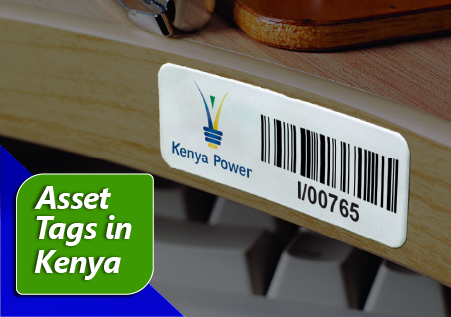
Choosing the right asset tag material can make the difference between a label that remains readable for years and one that peels, fades or becomes illegible within months. For businesses searching for aluminium asset tags Kenya suppliers can provide, the decision should be based on where the tag will be used, how much wear it will face and how long the asset needs to remain identifiable.
A laptop inside a Nairobi office does not need the same tag as a construction excavator operating in dusty conditions or a delivery vehicle travelling along the Northern Corridor.
For manufacturing, construction, agriculture and logistics businesses, three common options are worth comparing: anodized aluminium, polycarbonate and vinyl/paper stickers.
Aluminium Asset Tags Kenya: Which Material Performs Best?
The short answer is that anodized aluminium is generally the strongest choice for long-term identification of outdoor, industrial and high-value assets.
However, polycarbonate and vinyl still have useful applications where extreme durability is not required.
| Material | Durability Rating | Best Environment / Industry | Key Advantage |
|---|---|---|---|
| Anodized Aluminium | 10–20+ years | Construction, transport, agriculture, outdoor plants | UV-resistant, chemical-resistant and highly scratch-resistant |
| Polycarbonate | 5–7 years | IT departments, offices, hospitals | Flexible, sleek finish and medium durability |
| Vinyl/Paper Stickers | 1–2 years | Low-cost indoor tools and temporary items | Budget-friendly for short-term identification |
Actual service life depends on the tag specification, printing method, adhesive, surface and operating environment.
For assets expected to remain in service for many years, however, durable asset tags should be evaluated on total lifecycle value rather than purchase price alone.
Anodized Aluminium Asset Tags
Anodized aluminium is designed for demanding asset identification applications.
The anodizing process creates a durable oxide layer that helps protect the aluminium surface while allowing information such as serial numbers, barcodes, QR codes and logos to be incorporated into the tag.
This makes aluminium particularly suitable for assets that face sunlight, dust, abrasion, moisture and industrial handling.
Where Aluminium Asset Tags Work Best
Consider them for:
- Heavy construction machinery
- Agricultural equipment
- Generators
- Electrical equipment
- Industrial machinery
- Fleet vehicles
- Trailers
- Pumps
- Outdoor infrastructure
- Warehouse equipment
- Manufacturing plant equipment
For a contractor moving machinery between Nairobi, Nakuru, Eldoret and other project locations, the asset identifier may be exposed to significantly more wear than a label attached to an office desk.
Why Anodized Aluminium Is Durable
Quality anodized aluminium tags can offer strong resistance to:
- UV exposure
- Scratching
- Abrasion
- Oils and industrial contaminants
- Moisture
- Dust
- Temperature variation
- Routine cleaning
This is why anodized aluminium tags Nairobi businesses purchase are particularly appropriate for industrial and commercial assets that need long-term identification.
Polycarbonate Asset Tags
Polycarbonate occupies the middle ground.
It is a strong plastic material that offers more durability than ordinary paper labels while providing flexibility and a clean appearance.
For many indoor applications, this makes it a practical choice.
Best Applications for Polycarbonate
Polycarbonate tags can be appropriate for:
- Computers
- Office equipment
- Medical equipment
- Laboratory equipment
- Furniture
- IT infrastructure
- Indoor electrical equipment
- School equipment
For an IT department managing hundreds of laptops, monitors and networking devices in a controlled indoor environment, polycarbonate can provide a good balance between appearance, durability and cost.
Its flexibility can also make it suitable for surfaces where a rigid metal tag is unnecessary.
Where Polycarbonate May Fall Short
The important question is not whether polycarbonate is durable—it is.
The question is whether it is durable enough for your operating environment.
A tag exposed continuously to intense sunlight, heavy abrasion, mud, machinery oils or rough handling may benefit from a more heavy-duty aluminium specification.
Vinyl and Paper Asset Stickers
Vinyl and paper stickers remain popular because they are inexpensive and easy to produce.
They can be perfectly adequate for short-term or low-risk indoor identification.
For example, a business might use economical stickers to identify:
- Temporary equipment
- Low-value office items
- Short-term project materials
- Consumable storage containers
- Internal tools
- Items with a short operational life
The problem occurs when an organisation uses a low-cost sticker for an asset expected to remain identifiable for five, ten or fifteen years.
Why Cheap Labels Can Become Expensive
A sticker may initially cost less than an aluminium tag.
But consider what happens if it:
- Peels off.
- Fades.
- Gets scratched.
- Becomes unreadable.
- Leaves an asset without an identifier.
- Requires replacement.
- Creates discrepancies during an asset verification exercise.
The original saving can disappear quickly.
For high-value machinery, the cost of losing reliable identification can be much higher than the cost difference between materials.
How Kenya’s Climate Affects Asset Tag Selection
Kenya does not have one uniform operating environment.
A tag suitable for an air-conditioned Nairobi office may not perform equally well on equipment working in Mombasa, Turkana, the Rift Valley or a dusty construction site.
Coastal Humidity in Mombasa
Assets operating around Mombasa face high humidity, salt-laden air and moisture.
This matters particularly for:
- Port and logistics equipment
- Transport fleets
- Construction machinery
- Marine-adjacent equipment
- Warehousing operations
A poorly selected label can deteriorate faster in these conditions.
For critical outdoor assets, a properly specified anodized aluminium tag can provide a more robust identification solution than a basic paper or vinyl sticker.
Agricultural Wear in the Rift Valley
Agricultural equipment can face a combination of dust, mud, moisture, sunlight and mechanical abrasion.
Tractors, irrigation equipment, harvesters, pumps and other machinery may operate outdoors for long periods.
Tags may also encounter:
- Fertiliser residues
- Agricultural chemicals
- Grease
- Soil
- Pressure washing
- Repeated physical contact
This is an environment where durable asset tags need to be selected for the actual conditions rather than simply for their appearance.
Heat, Dust and Industrial Conditions
Industrial zones and regional project sites can expose equipment to heat, dust, vibration and frequent handling.
Think about equipment moving between a factory floor, warehouse and outdoor loading area.
The tag must remain:
Readable + attached + identifiable
throughout the asset’s operational lifecycle.
For heavy machinery, aluminium is generally the stronger choice.
Aluminium vs. Polycarbonate vs. Vinyl: Which Should You Buy?
The best material depends on the asset.
Choose Anodized Aluminium When
- The asset is outdoors.
- The equipment is expensive.
- The asset will be used for many years.
- The equipment is exposed to UV.
- The asset faces abrasion or harsh handling.
- Machinery operates in dusty or industrial environments.
- You need long-term barcode or QR identification.
- Equipment moves between multiple project sites.
Choose Polycarbonate When
- The asset is primarily indoors.
- Appearance is important.
- Moderate durability is sufficient.
- You are tagging IT or office equipment.
- The surface requires some flexibility.
Choose Vinyl or Paper When
- The asset is low-value.
- The identification is temporary.
- The item has a short lifecycle.
- The environment is controlled.
- Minimising initial cost is the main priority.
Why Barcode Tags Kenya Businesses Use Need the Right Material
The barcode is only useful if it remains readable.
A perfectly printed barcode that fades or becomes scratched is no longer a reliable asset identifier.
That is why barcode tags Kenya businesses use should be evaluated as a complete system, not simply by the quality of the barcode printing.
Consider four factors:
Barcode Quality
The barcode should be clear and scannable.
Surface Durability
The printed information needs to remain readable throughout the expected lifecycle.
Adhesion
The tag needs to remain securely attached to the asset.
Environmental Resistance
The material and finish should match the asset’s operating conditions.
For outdoor machinery, this combination makes anodized aluminium particularly attractive.
How Better Asset Tags Support Finance and Audit Controls
Asset tagging is not only an operations issue.
Finance teams depend on accurate asset records to understand what the organisation owns, where those assets are located and what condition they are in.
A physical asset identifier can help connect:
Purchase record → Asset register → Physical asset → Location → Custodian → Maintenance → Disposal
This can make physical verification more efficient.
For SMEs in Nairobi, for example, a periodic asset verification exercise can reveal equipment that has been moved between departments, relocated to another branch or incorrectly recorded.
For public entities, asset management and disposal also sit within Kenya’s public procurement and asset disposal framework. Organisations operating under the Public Procurement and Asset Disposal Act and its associated regulations should ensure their asset management procedures align with the applicable requirements.
The broader lesson for any organisation is straightforward:
If you cannot reliably identify an asset, it becomes much harder to reliably manage it.
Do Aluminium Asset Tags Cost More?
Usually, yes—the initial unit cost can be higher than basic vinyl or paper labels.
But procurement teams should consider total cost of ownership, not just the purchase price.
Imagine two options:
Option A: A cheap label that needs replacement every 12–24 months.
Option B: A higher-quality aluminium tag designed for long-term identification.
If the asset itself has a 10-year useful life, repeatedly replacing an inferior label can create unnecessary procurement, labour and verification costs.
There is also the less obvious cost of an unidentified asset.
If a tag fails and the asset becomes difficult to match to the FAR, the organisation may spend considerably more time investigating the discrepancy.
For high-value assets, the durability premium can therefore be justified.
How to Choose Aluminium Asset Tags in Kenya
Before placing an order, procurement teams should ask the supplier:
- What material and grade of aluminium is being used?
- Is the surface anodized?
- What printing or marking method is used?
- How long is the expected service life?
- Is the tag suitable for outdoor use?
- Can it include sequential asset numbers?
- Can it include barcodes or QR codes?
- What adhesive is recommended for the intended surface?
- Can samples be provided?
- Can the tags be customised with the organisation’s branding?
- Will the numbering system integrate with the existing asset register?
A free sample pack can be particularly useful when purchasing tags for machinery, vehicles or outdoor equipment.
Test the sample on the actual surface and, where practical, expose it to the conditions it will encounter.
Aluminium Asset Tags Kenya: The Bottom Line
There is no single asset tag material that is perfect for every application.
Vinyl and paper stickers make sense when low cost and short-term indoor identification are the priorities.
Polycarbonate provides a useful middle ground for many offices, hospitals and IT environments.
But when the requirement is long-term identification of expensive equipment in harsh Kenyan operating conditions, anodized aluminium is usually the strongest choice.
For construction machinery exposed to dust and UV, agricultural equipment operating in the Rift Valley, logistics assets moving along the Northern Corridor, or outdoor equipment exposed to coastal conditions in Mombasa, the durability of the tag should match the value and lifecycle of the asset.
The objective is not simply to buy a label.
It is to ensure that five, ten or twenty years from now, your organisation can still identify the asset, match it to its records and verify where it belongs.
Ready to Choose the Right Asset Tags for Your Business?
Don’t make a large procurement decision based solely on photographs or unit price.
Request a quote or order a free sample pack of asset tags in Kenya and compare the material, print quality, barcode readability, adhesive and finish against your actual operating conditions.
Whether you need aluminium asset tags for heavy machinery, barcode tags for IT equipment, or durable asset tags for a fleet, choosing the right material at the beginning can save your organisation repeated replacement costs and asset-control headaches later.
Get your free sample pack or request a quote today.
Read More:
How Anodized Aluminium Asset Tags Withstand Harsh Industrial Environments in Kenya, Barcode vs. QR Code vs. RFID Asset Tags: Choosing the Right Solution for Your Nairobi Office, Public Sector & Corporate Compliance: A Guide to Asset Tracking Regulations in Kenya, Aluminium Asset Tags vs. Vinyl vs. Polycarbonate: Which Is Best for Your Kenyan Industry? Top 7 Causes of Asset Loss in Kenyan Businesses (And How Fixed Asset Tags Solve Them)