
A missing laptop, an unrecorded transfer of equipment between branches, or machinery that disappears during a site relocation can create more than an operational headache. For Kenyan businesses, schools and organisations, poor asset control can lead to inaccurate financial records, difficult audits, unnecessary replacement costs and weak accountability.
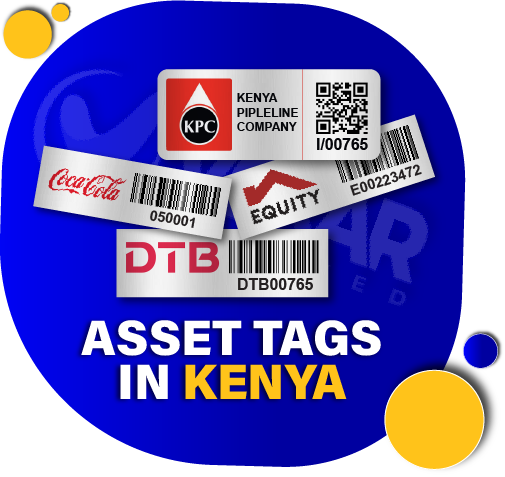
Fixed asset tags Kenya businesses use to identify and track physical assets can provide a simple foundation for solving these problems. When every qualifying asset carries a unique identification number, barcode or QR code linked to the organisation's fixed asset register (FAR), finance and operations teams have a physical reference point for verifying what they own, where it is and who is responsible for it.
Here are seven common causes of asset loss—and how a structured fixed asset tagging system can help address them.
1. Ghost Assets and Inaccurate Fixed Asset Registers
One of the most overlooked asset-management problems is the ghost asset: an item appearing in the fixed asset register but which can no longer be physically located.
Imagine a Nairobi company with hundreds of computers, printers, office chairs and other equipment recorded over several years. Some assets may have been disposed of, transferred, replaced or written off, while the original records remain unchanged.
The result is a FAR that looks complete on paper but does not accurately reflect the organisation's physical assets.
How fixed asset tags help
A unique asset tag creates a direct connection between the physical asset and its accounting record.
During an asset verification exercise, an auditor or finance officer can scan or read the tag and compare it against the FAR.
A good tagging system should capture information such as:
- Unique asset identification number
- Asset description
- Department or cost centre
- Location
- Custodian
- Acquisition information
- Barcode or QR code where appropriate
- Status of the asset
This makes periodic physical verification much easier and helps identify discrepancies between the register and what actually exists.
Fixed asset tracking is therefore not simply about sticking labels on equipment. It is about creating a reliable identification layer between physical assets and asset records.
2. Unrecorded Movement Between Offices, Branches and Sites
Assets rarely stay in one place forever.
A laptop may move from the Nairobi head office to a branch in Mombasa. Furniture may be transferred from one school campus to another. Construction equipment may move between project sites. IT equipment may be relocated when departments are reorganised.
If these movements are not documented, the asset register gradually becomes unreliable.
The problem with informal transfers
A common process looks like this:
Office A → “Please send the printer to Office B.”
The printer moves. Nobody updates the register.
Months later, an asset verification team searches for it at Office A and marks it as missing.
The asset has not necessarily been lost—it has simply become untraceable within the organisation's records.
Fixed asset tags create a physical control point
A clearly marked tag allows staff at the receiving location to immediately identify the asset.
For stronger controls, the organisation should combine the tag with a documented transfer process:
- Scan or record the asset number.
- Record the current location.
- Record the new location.
- Update the custodian or department.
- Update the FAR or asset tracking software.
- Confirm receipt at the destination.
This is particularly valuable for organisations with multiple branches, schools, warehouses or geographically dispersed projects.
3. Employee Theft and Unauthorised Asset Removal
Asset theft becomes significantly harder to detect when equipment has no unique identification.
A laptop without an asset number can be difficult to distinguish from another similar laptop. A power tool or piece of equipment may leave a warehouse without anyone knowing exactly which unit was removed.
Asset tags do not eliminate theft, but they improve accountability and make assets easier to identify, audit and investigate.
Use asset tags as part of a wider loss-prevention system
For example, a company can require employees to provide the asset number when:
- Taking equipment off-site
- Returning equipment
- Changing departments
- Handing equipment to another employee
- Reporting a damaged or missing asset
- Returning company property when leaving employment
The physical tag becomes a visible reminder that the asset belongs to the organisation and is individually accountable.
For businesses looking for loss prevention Nairobi solutions, this simple layer of physical identification can complement access controls, CCTV, stock controls and asset management software.
4. Misplaced Machinery During Site Moves
This is particularly relevant to Kenyan businesses operating construction, engineering, manufacturing, logistics and field-service operations.
Equipment can move frequently between locations, especially when projects are completed and machinery is redeployed.
Consider a contractor moving equipment between Nairobi, Nakuru and sites along the Northern Corridor. Several machines may look similar, while transport teams and subcontractors may handle different items at different stages.
Without unique identification, it becomes difficult to establish:
- Which machine was sent?
- Where was it sent?
- Who received it?
- When was it transferred?
- When was it returned?
- Was it damaged during transit?
- Is it currently deployed or idle?
Fixed asset tags provide a consistent identity
A durable asset tag gives every machine a unique reference that remains associated with it throughout its useful life.
The tag can be linked to information such as:
Asset ID → Machine → Department → Site → Custodian → Maintenance history
That information can then be maintained in a spreadsheet, ERP platform or dedicated asset tracking software Kenya businesses use for larger asset portfolios.
5. Poor-Quality Labels That Fail in Kenyan Operating Conditions
Not every asset label is suitable for long-term fixed asset identification.
A cheap paper or low-grade vinyl label may work inside a clean office but fail when exposed to:
- Strong sunlight and UV exposure
- Dust
- Heat
- Moisture
- Frequent handling
- Abrasion
- Cleaning chemicals
- Outdoor work environments
This matters for organisations operating outside controlled office environments.
Equipment used at regional job sites, warehouses, farms, workshops and construction projects may face substantially harsher conditions than an office printer in Nairobi.
Anodized aluminium vs. vinyl asset tags
| Feature | Anodized Aluminium | Vinyl |
|---|---|---|
| Durability | Excellent | Good |
| UV resistance | Excellent | Moderate to good, depending on grade |
| Abrasion resistance | Excellent | Moderate |
| Outdoor applications | Excellent | Suitable for selected applications |
| Machinery | Excellent | Suitable for lighter-duty applications |
| Office equipment | Excellent | Excellent |
| Long-term identification | Excellent | Good |
| Cost | Generally higher | Generally lower |
Anodized aluminium asset tags are particularly useful when long service life and durability are priorities.
Vinyl can be an economical option for indoor equipment and applications where extreme durability is not required.
The right material should therefore be selected according to the asset's environment—not simply the lowest initial price.
6. Poor Asset Disposal and Replacement Controls
Another source of asset discrepancies is what happens after an asset reaches the end of its useful life.
A company may replace computers, furniture, machinery or other equipment but fail to properly update the register.
This can produce two problems:
- The old asset remains on the records.
- The replacement asset is not properly added and identified.
Over time, the organisation accumulates inaccurate records and loses visibility of its actual asset base.
Tagging supports the asset lifecycle
A strong system should follow an asset from:
Acquisition → Tagging → Assignment → Transfer → Maintenance → Verification → Disposal
The tag provides the persistent identifier used throughout that lifecycle.
For public entities, asset management and disposal are particularly important under Kenya's public procurement and asset disposal framework. PPRA notes that the Public Procurement and Asset Disposal Act provides the framework for efficient public procurement and asset disposal by public entities.
The associated Regulations also address the custody, care, control and use of public assets and require records around assets, including processes for losses and transfers.
For private organisations, the same principles represent strong internal controls even where the specific public-sector legal framework does not apply.
7. Infrequent or Incomplete Asset Verification
An organisation can have an excellent asset register and still lose control of its assets if nobody regularly verifies what is physically present.
This is where many organisations encounter problems during internal audits, external audits or management reviews.
What happens during physical verification?
The verification team needs to answer basic questions:
- Does the asset physically exist?
- Does the asset number match the register?
- Is it in the recorded location?
- Is the assigned custodian correct?
- Is it operational?
- Has it been transferred?
- Is it damaged or obsolete?
- Should it be retained, repaired or disposed of?
Without a visible asset identifier, this process can become slow and error-prone.
With a barcode or QR-enabled asset tag, verification can become substantially more systematic.
How Fixed Asset Tags Fit Into a Complete Asset Tracking System
Fixed asset tags Kenya organisations deploy should not operate in isolation. The strongest results come when physical identification is combined with accurate records and defined processes.
Think of the system as three layers:
Layer 1: Physical Identification
The asset receives a unique, durable tag.
Example:
VEX-IT-004582
The tag may include a barcode or QR code.
Layer 2: Asset Register
The unique number is linked to the organisation's FAR, spreadsheet or asset management system.
The record may contain:
- Asset description
- Serial number
- Purchase date
- Purchase cost
- Location
- Department
- Custodian
- Condition
- Depreciation information
- Maintenance records
- Disposal status
Layer 3: Controls and Verification
The organisation establishes procedures for:
- Asset transfers
- New asset tagging
- Periodic verification
- Lost asset reporting
- Damage reporting
- Employee handover
- Disposal
- Changes in location or custody
This is where asset tracking software Kenya organisations use can add significant value, particularly when hundreds or thousands of assets are distributed across multiple locations.
But software is only as reliable as the physical identification and data behind it.
A sophisticated system cannot accurately track an asset that has no reliable identity.
Why Quality Asset Tags Matter for Finance and Procurement Teams
For finance officers and procurement teams, asset tagging is not merely an operations exercise.
Accurate asset identification can support:
Better audit readiness
A physical tag gives auditors and internal verification teams a clear reference when checking assets against records.
Better accountability
Departments and custodians can be held responsible for assets assigned to them.
Better lifecycle management
Knowing what equipment exists, where it is and what condition it is in helps management make better replacement and maintenance decisions.
Reduced unnecessary purchases
An organisation may discover that equipment it thought was missing is actually sitting at another branch or department.
Better disposal decisions
Accurate records help distinguish active, obsolete, damaged and surplus assets.
Stronger internal controls
A unique identification system makes it harder for assets to disappear into an undocumented gap between procurement, operations and finance.
What Should You Look for When Buying Fixed Asset Tags in Kenya?
Before ordering, consider the following:
1. Material: Choose aluminium for demanding environments and durable vinyl for suitable indoor applications.
2. Adhesive: The adhesive should match the surface and expected environmental conditions.
3. Identification method: Decide whether you need sequential numbers, barcodes, QR codes or a combination.
4. Readability: Text and codes should remain legible throughout the expected asset lifecycle.
5. Customisation: Include your organisation's name, logo or other relevant information where useful.
6. Durability: Consider UV, abrasion, moisture, dust and cleaning exposure.
7. Asset management compatibility: Ensure the numbering structure works with your existing FAR or asset tracking software.
8. Sampling: Request a sample before placing a large order, particularly if tags will be used outdoors or on machinery.
Fixed Asset Tags Kenya: A Small Control That Can Protect a Large Asset Base
Asset loss rarely comes from one dramatic event. More often, it develops through small control failures: an unrecorded transfer, a missing laptop, an outdated register, an incorrectly labelled machine or equipment moved between sites without documentation.
Fixed asset tags Kenya businesses use provide the physical identification layer needed to close many of these gaps.
For finance managers, operations heads, procurement teams and school administrators, the objective is simple:
Know what you own, know where it is, know who is responsible for it, and keep the records accurate.
Whether you manage a Nairobi office, a school with multiple campuses, a warehouse, a manufacturing facility or equipment spread across regional project sites, a properly designed asset tagging system can make physical verification faster, improve accountability and strengthen your overall fixed asset controls.
The best time to discover that an asset is missing is before the audit—not during it.
Ready to Improve Your Asset Tracking?
If you are looking for fixed asset tags in Kenya, choose tags designed around the environment and lifecycle of your assets.
Request a quote or order a free sample pack of asset tags in Kenya and compare the material, print quality, barcode readability, adhesive and finish against your actual operating conditions.
Whether you need aluminium asset tags for heavy machinery, barcode tags for IT equipment, or durable asset tags for a fleet, choosing the right material at the beginning can save your organisation repeated replacement costs and asset-control headaches later.
Get your free sample pack or request a quote today.
Read More:
How Anodized Aluminium Asset Tags Withstand Harsh Industrial Environments in Kenya, Barcode vs. QR Code vs. RFID Asset Tags: Choosing the Right Solution for Your Nairobi Office, Public Sector & Corporate Compliance: A Guide to Asset Tracking Regulations in Kenya, Aluminium Asset Tags vs. Vinyl vs. Polycarbonate: Which Is Best for Your Kenyan Industry? Top 7 Causes of Asset Loss in Kenyan Businesses (And How Fixed Asset Tags Solve Them)
Need asset tags for your organisation?
Tell us the tag type, size and quantity. Minimum order 100 pcs, and 500 tags can be ready in 1 day.