
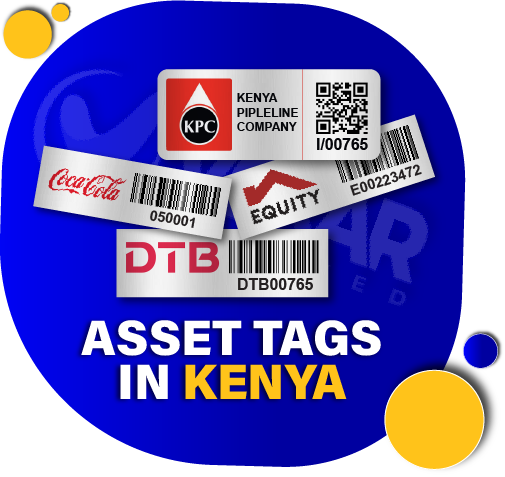
Choosing the right identification technology can determine how efficiently your Nairobi office tracks computers, monitors, furniture, networking equipment and other fixed assets. For businesses comparing asset tags Kenya suppliers offer, the choice is no longer limited to a simple printed number. Barcode, QR code and RFID technologies each solve different asset-management problems.
For a startup with 50 laptops, a QR-coded tag may be more practical than RFID. For an office with several hundred IT assets, traditional barcodes can provide a cost-effective balance between speed and simplicity. For a warehouse handling thousands of items, RFID may deliver advantages that manual scanning cannot match.
The right technology depends on your asset volume, environment, budget, existing systems and verification requirements.
Asset Tags Kenya: Barcode vs. QR Code vs. RFID
Before choosing a technology, it helps to understand what each system actually does.
| Technology | Scanning Method | Typical Range | Best For | Relative Cost |
|---|---|---|---|---|
| Barcode | Optical scanner/camera | Short range | Office assets and standard inventory | Low |
| QR Code | Smartphone/camera scanner | Short range | IT assets and digital records | Low–Medium |
| RFID | Radio frequency | From a few cm to several metres depending on system | Warehouses and high-volume inventory | Medium–High |
| Human-readable number | Manual | Direct visual identification | Basic asset registers | Very low |
The important point is that the technology is only one part of the solution.
The tag material, adhesive, numbering structure, database and verification process all affect the overall performance of an asset identification programme.
How Barcode Asset Tags Work
A barcode represents information using a pattern that can be read by a compatible scanner or camera.
For fixed asset management, the barcode can represent a unique asset number.
For example:
NBO-IT-001245
The barcode is linked to that number in the organisation’s asset register.
When an employee scans the tag, the system can retrieve the corresponding asset record.
Why Barcodes Remain Popular
Barcodes are particularly effective because they are:
- Affordable
- Easy to print
- Quick to scan
- Widely supported
- Easy to generate sequentially
- Suitable for large numbers of assets
- Familiar to most inventory teams
For a Nairobi office with hundreds of computers, monitors, printers and other equipment, barcode tags can provide a straightforward way to speed up physical verification.
They can also be useful when an organisation already has barcode scanners or asset-management software that supports barcode identification.
When Should You Choose Barcode Asset Tags?
Choose barcodes when your primary requirement is simple and reliable asset identification.
They are especially suitable for:
- Office IT equipment
- Furniture
- Printers
- Networking equipment
- School assets
- Warehouse equipment
- General corporate fixed assets
If your organisation only needs to answer “Which asset is this?” and retrieve the corresponding record, a barcode may be all you need.
How QR Code Asset Labels Work
QR codes are two-dimensional codes capable of storing considerably more information than a conventional one-dimensional barcode.
Most modern smartphones can scan QR codes using their built-in cameras.
This makes QR code asset labels attractive for organisations that want employees and administrators to interact with asset information without specialised barcode scanners.
A QR code could direct an authorised user to an internal asset record containing information such as:
- Asset ID
- Asset description
- Assigned employee
- Department
- Location
- Maintenance history
- Warranty information
- Verification status
The exact information available depends on the software or database connected to the QR code.
Why QR Codes Work Well for Nairobi Offices
Many modern offices already rely heavily on smartphones, cloud systems and web-based applications.
This means a QR-based asset system can potentially reduce the hardware requirements for routine identification.
For example, an IT administrator conducting an asset verification exercise could use a smartphone to scan a laptop’s QR code and retrieve its corresponding record.
That can be particularly useful for:
- Startups
- Technology companies
- Co-working spaces
- Corporate offices
- Schools and universities
- IT departments
- Facilities teams
QR Codes Are Not Automatically an Asset Management System
A common misconception is that placing a QR code on an asset automatically creates digital asset management.
It does not.
The QR code needs to point to a reliable destination or contain an identifier that can be connected to a properly maintained asset database.
If the underlying records are incomplete, scanning the code will not solve the data-quality problem.
The technology should therefore support an existing asset-management process rather than replace it.
How RFID Asset Tags Work
RFID, or Radio Frequency Identification, uses radio waves to identify tags.
Unlike a barcode or QR code, RFID does not necessarily require the tag to be directly visible to the reader.
This creates important advantages for certain environments.
An RFID reader can potentially identify multiple tagged items within its operating range, depending on the RFID system, tag type, reader and environment.
That makes RFID particularly attractive for high-volume inventory operations.
When RFID Makes Sense
RFID can be useful for:
- Large warehouses
- Distribution centres
- Logistics operations
- High-volume equipment inventories
- Pallet tracking
- Rapid stock movement
- Organisations with very large asset portfolios
Imagine a warehouse receiving dozens of tagged items at once.
With a suitable RFID setup, staff may be able to identify multiple assets without individually pointing a scanner at every tag.
That is where RFID can offer a significant operational advantage over conventional barcodes.
Barcode vs. QR Code vs. RFID: Which Should Your Nairobi Office Choose?
The right answer depends on the problem you are trying to solve.
Choose Barcode When Simplicity Matters
Barcode is usually the sensible choice when:
- You have a moderate number of assets.
- You already use barcode scanners.
- You need low-cost identification.
- Assets can be scanned individually.
- Your asset-management software supports barcodes.
- You mainly need unique identification.
For many offices, this is sufficient.
There is little value in implementing a more expensive technology simply because it is technically more advanced.
Choose QR Codes When Smartphone Access Matters
QR codes are attractive when:
- Employees already use smartphones.
- You want quick camera-based scanning.
- You want to link tags to digital records.
- You need more flexibility than a basic barcode.
- Your IT team wants easy access to asset information.
For a modern Nairobi office, QR codes can provide a practical bridge between physical assets and digital workflows.
Choose RFID When Speed and Scale Matter
RFID becomes more compelling when:
- You manage thousands of items.
- Assets move frequently.
- Manual scanning is too slow.
- You operate a warehouse or distribution centre.
- You need rapid bulk identification.
- The business case justifies additional hardware and infrastructure.
RFID is therefore usually less about replacing barcodes in an office and more about solving a high-volume tracking problem.
Asset Tags Kenya Businesses Should Choose Based on Asset Type
Technology should also be matched to the physical asset.
A laptop inside an air-conditioned Nairobi office has very different requirements from a generator operating outdoors or equipment moving through a logistics facility.
| Asset | Recommended Technology | Recommended Material |
|---|---|---|
| Office laptop | QR or barcode | Polycarbonate or durable vinyl |
| Desktop computer | Barcode or QR | Polycarbonate/vinyl |
| Office furniture | Barcode | Durable vinyl or aluminium |
| Network equipment | QR or barcode | Polycarbonate/aluminium |
| Outdoor generator | Barcode/QR | Anodized aluminium |
| Construction machinery | Barcode/QR/RFID depending on workflow | Anodized aluminium |
| Warehouse inventory | RFID or barcode | Industrial-grade tag |
| Fleet vehicle | Barcode/QR/RFID depending on system | Durable aluminium |
For high-value assets, identification should remain readable throughout the expected lifecycle.
Why Tag Material Still Matters
Choosing barcode, QR or RFID does not eliminate the need to select the correct physical tag material.
A sophisticated QR system is useless if the printed code fades after months of UV exposure.
Similarly, a barcode scanner cannot identify an asset if the label has peeled away.
Indoor Office Applications
For most controlled indoor environments, vinyl or polycarbonate may provide adequate durability.
They can work well for:
- Computers
- Monitors
- Office furniture
- Printers
- Telephones
- IT equipment
Outdoor and Industrial Applications
For equipment exposed to sunlight, dust, moisture, chemicals or abrasion, anodized aluminium is often a stronger option.
This can be particularly relevant for businesses operating equipment at construction sites, agricultural locations, transport yards or regional facilities.
Asset Tag Printing Nairobi: What Should You Ask For?
When sourcing asset tag printing Nairobi businesses can use for large-scale identification projects, don’t focus only on the price per tag.
Ask suppliers about:
- Sequential numbering
- Barcode generation
- QR code generation
- Print durability
- Material options
- Adhesive strength
- UV resistance
- Scratch resistance
- Tag dimensions
- Logo and branding
- Sample availability
- Compatibility with your asset-management system
Requesting samples before a large order is particularly useful.
A sample allows the procurement or IT team to test:
- Scanning reliability.
- Adhesion to the actual asset surface.
- Readability at different distances.
- Resistance to cleaning.
- Appearance.
- Compatibility with existing software.
How Asset Tags Support Asset Verification
One of the most practical benefits of digital asset identification is faster physical verification.
Consider a Nairobi company with 1,000 IT and office assets.
Without asset tags, an administrator may have to compare serial numbers, descriptions and locations manually.
With a unique barcode or QR code, the workflow becomes:
Locate asset → Scan tag → Retrieve record → Confirm location → Verify custodian → Update status
This can reduce manual data entry and make discrepancies easier to identify.
For larger organisations, the same approach can support periodic internal audits and asset reconciliation exercises.
Asset Tags and Kenya’s Public Asset Management Framework
Although this article focuses on corporate and office environments, the same identification principles are relevant to public institutions.
Kenya’s Public Procurement and Asset Disposal framework places importance on maintaining records and inventories of assets, while public-sector asset management guidelines provide for physical verification and asset reporting.
A well-designed tagging system can therefore help institutions create a clear connection between the physical asset and its formal records.
Universities, public offices and other institutions with large asset inventories can use numbered, barcode or QR-coded fixed asset tags Kenya organisations require for structured asset identification.
The specific compliance obligations will depend on the organisation and whether it falls within the relevant public-sector framework.
What About RFID for Office IT Assets?
RFID can sound attractive because it is more advanced than conventional barcodes.
But “more advanced” does not always mean “better.”
If your Nairobi office has 300 laptops and your IT administrator performs a quarterly verification, QR or barcode tags may be more economical and easier to deploy.
RFID becomes more compelling if the organisation needs to locate or count large volumes of assets rapidly.
For example, an organisation operating a warehouse alongside its Nairobi headquarters may reasonably use:
QR/barcodes for office assets + RFID for warehouse operations.
There is no requirement to use one technology for every asset.
A hybrid strategy can sometimes deliver the best balance of cost and performance.
How to Build a Practical Asset Tagging System
Regardless of the technology selected, start with the process.
Step 1: Build the Asset Register
Identify what assets you own and establish a unique identification structure.
Step 2: Categorise Assets
Separate assets by type, value, location and operating environment.
Step 3: Select the Technology
Choose barcode, QR, RFID or a combination based on actual operational requirements.
Step 4: Select the Material
Choose vinyl, polycarbonate or aluminium based on environmental exposure and expected lifespan.
Step 5: Tag Every Relevant Asset
Apply tags consistently and ensure the asset number matches the register.
Step 6: Connect Tags to Your Records
Link the barcode, QR code or RFID identifier to the relevant asset-management system.
Step 7: Establish Verification Procedures
Schedule periodic physical checks and update locations, custodians and asset status.
Step 8: Review the System
Monitor scanning performance, tag failures and data accuracy and improve the process where necessary.
Asset Tags Kenya: Which Technology Is Right for You?
For most Nairobi offices, the decision does not need to be complicated.
Barcode is the practical choice for straightforward, low-cost asset identification.
QR codes are ideal when smartphone scanning and digital access to asset records are important.
RFID is most useful when the organisation needs rapid, high-volume identification and is prepared to invest in the necessary readers and infrastructure.
The best system is not necessarily the most technologically sophisticated one.
It is the system that your organisation can afford, deploy consistently and maintain accurately over the entire asset lifecycle.
For businesses looking for asset tags Kenya suppliers can customise with sequential numbers, barcodes or QR codes, start by identifying the assets you need to track and the environment in which those assets operate.
Then choose the technology that solves the actual problem.
Ready to Upgrade Your Asset Identification System?
Whether you need barcode tags for an office IT department, QR code asset labels for a growing Nairobi startup or a more advanced RFID solution for high-volume inventory, the first step is selecting the right physical tags and identification system.
Request a quote or order a free sample pack of asset tags in Kenya and compare the material, print quality, barcode readability, adhesive and finish against your actual operating conditions.
Whether you need aluminium asset tags for heavy machinery, barcode tags for IT equipment, or durable asset tags for a fleet, choosing the right material at the beginning can save your organisation repeated replacement costs and asset-control headaches later.
Get your free sample pack or request a quote today.
Read More:
How Anodized Aluminium Asset Tags Withstand Harsh Industrial Environments in Kenya, Barcode vs. QR Code vs. RFID Asset Tags: Choosing the Right Solution for Your Nairobi Office, Public Sector & Corporate Compliance: A Guide to Asset Tracking Regulations in Kenya, Aluminium Asset Tags vs. Vinyl vs. Polycarbonate: Which Is Best for Your Kenyan Industry? Top 7 Causes of Asset Loss in Kenyan Businesses (And How Fixed Asset Tags Solve Them)